A week of spinning plates

It’s been an interesting week musically, with a whole host of different plates successfully kept spinning. There were a few occasions where they almost came crashing down, but not quite.

Closet Organ-9203.jpg

First off, the BBC came round to record a short interview about the music, which is pretty cool. It should be up sometime soon, so watch this space. It had to be the time where my LSDJx2 refused to synch properly of course. Sod’s law.

Next up, I launched the noisepedals.com site to look at different effects boxes and electronic instruments – which means I get to record and experiment with sounds that I’d not normally have had a chance to.

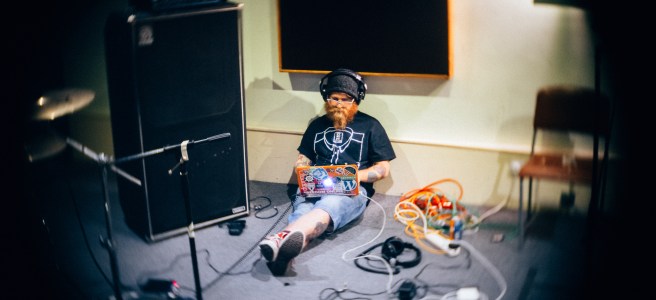
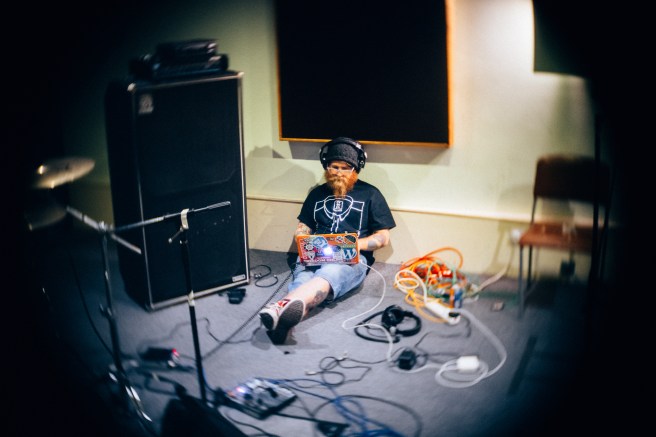
Then, on Sunday I headed into the studio with the newly re-born Closet Organ – a grunge band that was formed with some pals way back in High School; this time with Lee on board as second guitar which gives it an interesting new dynamic. After initially forgetting my laptop (eugh), we got three tracks done in five hours. Not bad at all. Looking forward to getting a whole bunch more done in the next few months.

Coming back to unexpected bowtie, the final tracks of the new album are coming together, so it shouldn’t be too long before I’m able to release it. It’s still missing something though. It’ll be a bit quieter over the next few days as non-music life takes over, but it feels good to be busy again.

NoisePedals.com

One of the things that’s always driven me to play about with different gear is a craving to find new and interesting sounds. It’s what led me to the whole chipmusic world in the first place, and continues to develop in different ways.

Over the past few months I’ve begun to really appreciate the huge range of weird and wonderful effects pedals that have been released by boutique manufacturers. It’s become a bit of an obsession actually. The problem when buying things like this is that you can’t really fire down to a shop down the road to plug in your Gameboy and see what a pedal will or won’t sound like – and almost all of the demos online are primarily focused on playing warbly guitar riffs. Nae use to somebody who wants to process LSDJ’s noise channel!

That has spurred me to set up my own pedal demo site, where I’ll feature some of the more unusual pedals that cross my path – and do so using the sort of instruments that I actually use to make music with: Gameboys, synths, keyboards, drum machines, Commodore 64s… etc. No fiddly guitar riffs here.

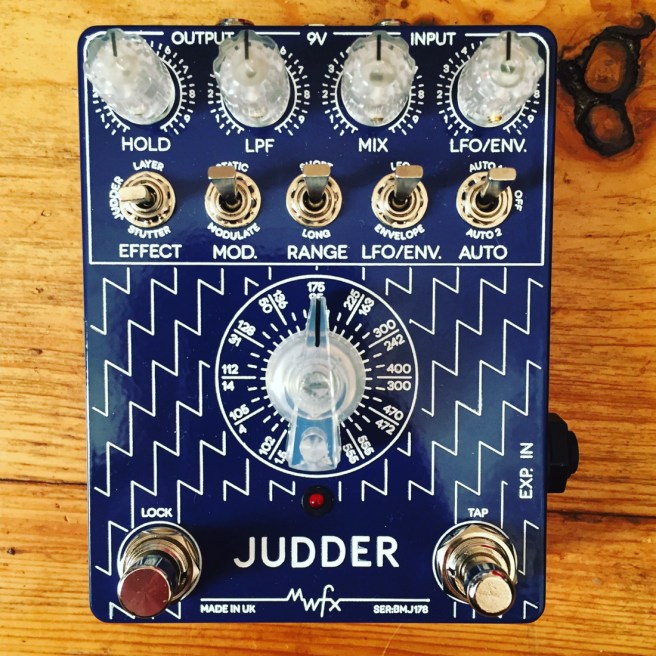
The first post has just gone up, and takes a look at the MWFX Judder pedal. This beast:

img_9509-1.jpg

Take a gander:

http://noisepedals.com/2016/03/17/mwfx-judder-pedal-review/

Mr. K

It’s been a while since I got pished on a Saturday night and just recorded some music. Well, I ended up recording after an hour of fighting with my mixer to work out why the stereo output was only producing mono…

There’s always the risk that it could have been my crappy soldering, which meant testing out every possible step. So many variables. Surprisingly, it wasn’t actually any of the Gameboys, but the mixer.

I’m pretty pleased with the result, and it should give a hint as to what the next album will sound like. Listen to and download it below:

To finish off, here’s a picture of my tidied up workspace.

Patchblocks as Effects Processor

Recently I came across a modular synth system called Patchblocks, and thought I’d give it a bash, as the components themselves weren’t too expensive.

The idea is pretty simple, but deceptively powerful. Essentially you get various inter-connecting blocks that all have two nobs and two buttons, as well as stereo audio out/in ports. By connecting them up to a computer via USB you can use dedicated software to program them to do a whole host of different things, such as simulating drum beats, or acting as effects processors. The latter is what I am particularly interested in.

The device itself is pretty sweet, and doesn’t take up too much room, with a footprint just over the size of a credit card. I plucked for the clear blue plastic version, which apparently glows in UV light… you know… for all those times I’ll be playing live.

The build quality is good, and despite an exposed PCB on the sides, it feels pretty solid.

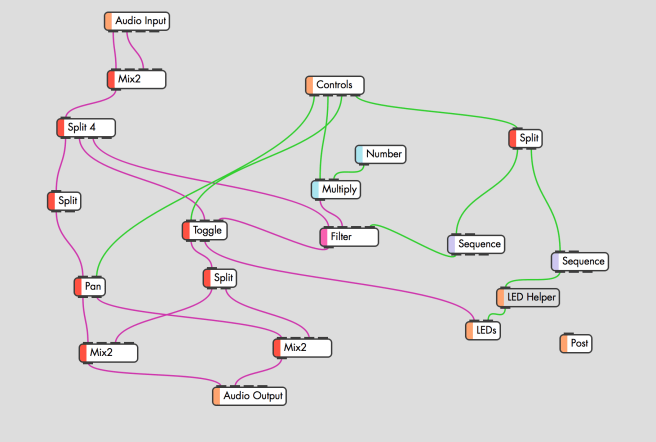
The coolest thing about these blocks is that you can set it up in whichever way suits your workflow best, rather than just ‘making do’ with workarounds. I’m always on the look out for different audio effects, and one of the things I miss when recording is having a hardware panning control. Sure, I could always just make use of a MIDI controller, but that still routes into Logic’s automation feature, which has never quite agreed with me. So, I set up one of the knobs to correspond to audio panning. That left me with two buttons and one knob free. I added in a filter, with the remaining knob controlling the frequency, and the right button switching through between High-Pass, Low-Pass, etc. The other button I set up as a bypass, so when it was ‘on’, the filter was active. The LEDs also correspond to the particular different modes.

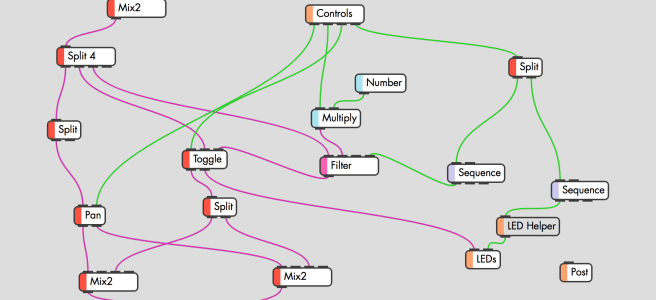
Here’s what that all looks like in the patchblocks software:
Screen Shot 2016-02-19 at 17.19.58.png

It looks complicated, but it isn’t really when you get used to it. Just like that, I have an effects unit that’s customised to do exactly what I need, and which I can modify at any point. Pretty cool.

If you’ve got a patchblock yourself you can check it out here. You’ll need the custom ‘LED Helper’ block that you can get on the Community download section of PB.

Sadly the block I received seemed to have a dodgy output when the audio input circuit was running, so I’ve sent it back for a replacement. The PB people couldn’t have been any nicer about it though, so I’m looking forward to testing it out properly when it comes back.

If you like hardware controls, but want to be able to fulfill a host of different functions in just a few boxes, check out the patchblocks. If you’re into the synth side of things more than the effects, there’s even a dedicated block to provide MIDI DIN in/out functionality. That’s something I might have to explore at a later date.

Update: I got my replacement unit back, and whilst some of the artefacts have been cleaned up, the quality is still noticeably worse than the input. It looks like it’s down to the sample rate of the unit itself, which is a shame – as it limits their usefulness as effects processors.

plowing around

horseface.gif

I’ve been bashing away writing and recording over the past few weeks, building up a decent library of tracks, and seeing what I can do with the various different apps that are available for the iPad. Lots of them make pretty cool sounds or loops in of themselves, but aren’t much use for anything other than that. There is some good stuff in there though.

The aim is to record as many tracks as possible, even if I don’t have an immediate specific use for them. This is a bit of a change from what my approach has always been… namely, an impatient one that meant I’d release pretty much everything I finished. Now, I’m getting a better handle on my gear setup, and certain songs are floating to the top naturally. It can be frustrating at times, but taking the longer road will hopefully result in some of the best stuff I’ve done as unexpected bowtie. I’m toying with the idea of releasing the rest as a sort of odds-and-ends EP as well.

We’ll see.

Hungover music making

On Saturday night a few of us headed out (full of rum) to belt out classic power ballads for a few hours. It was good times.

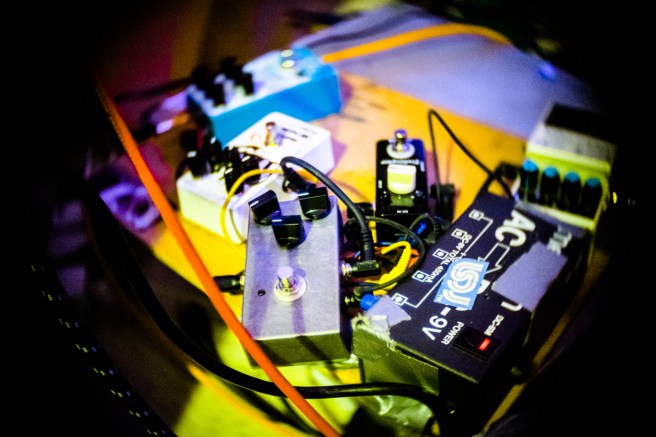
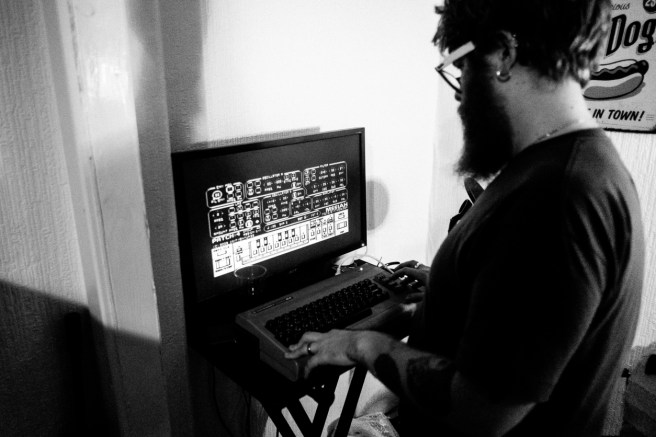
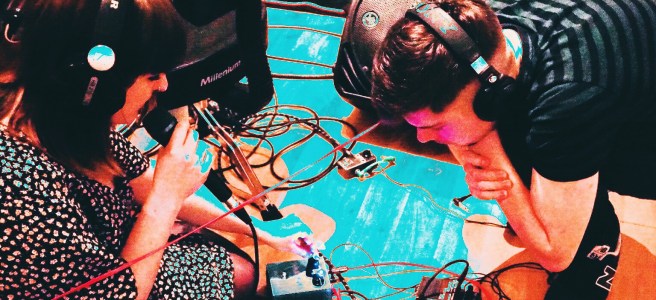
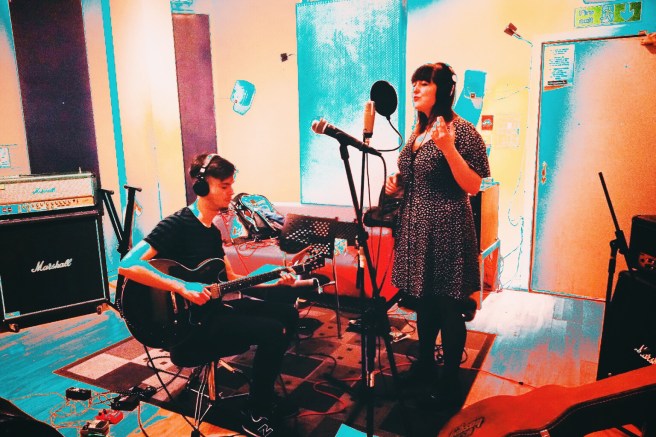
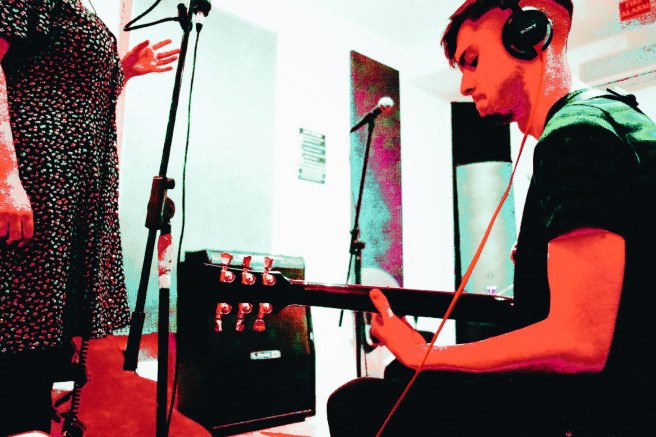
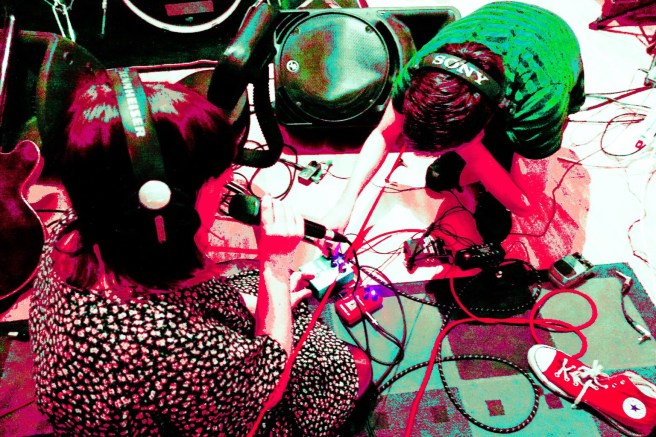
We didn’t feel all that great on Sunday though. Normally I’d just lie about and eat rubbish all day, which eh… I did anyway. But Lee aka radiomoths came round and we recorded the base of a new track with a bunch of different pedals, synths, and the C64. It’s all de-tuned and sounds a bit like the soundtrack of some robot death march from a film. Lee also took photos that I’ve stolen from his blog.

12710909_534516013377059_3833174918513592285_o.jpg

glasgow-8283.jpg

glasgow-8294.jpg

glasgow-8286.jpg

After we were done, I ate some more rubbish food. Not too bad a way to get through a hangover.


Somewhere Over the Rainbow

IMG_0302.JPG

On Friday I spent some time in the studio working on different tracks. One of them was an experimental cover of ‘Somewhere Over the Rainbow’ with my sister and her boyfriend singing and playing guitar. They studied music at University, and it was nice to record with people who knew what they were doing.

IMG_0301.JPG

We used a bunch of different effects to layer the sound up, and I added in chip drums later on.

IMG_0299.JPG

You can hear and download the track below. It’s ‘Somewhere Over the Rainbow’ like you’ve never heard it before. In someone else’s words:

I could imagine it being played at a f**** up fun fare with porcelain dolls singing as they go round in a Ferris wheel.

Transforming a Gameboy

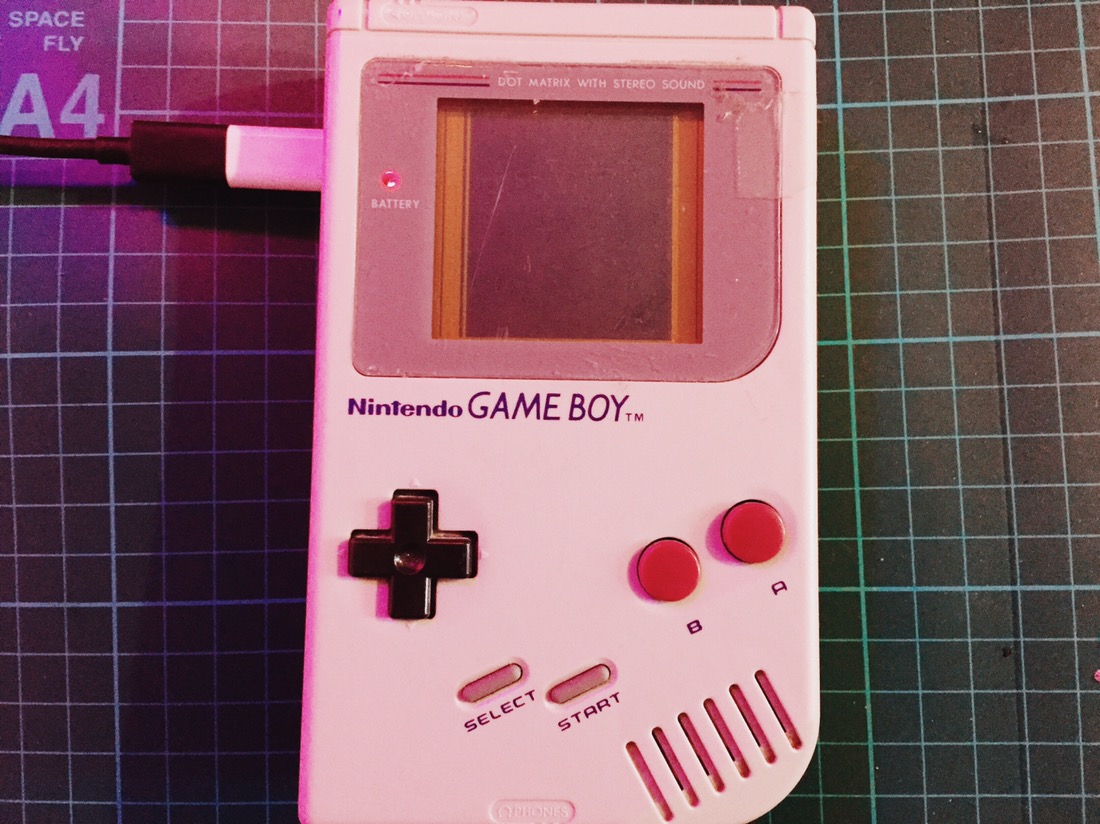
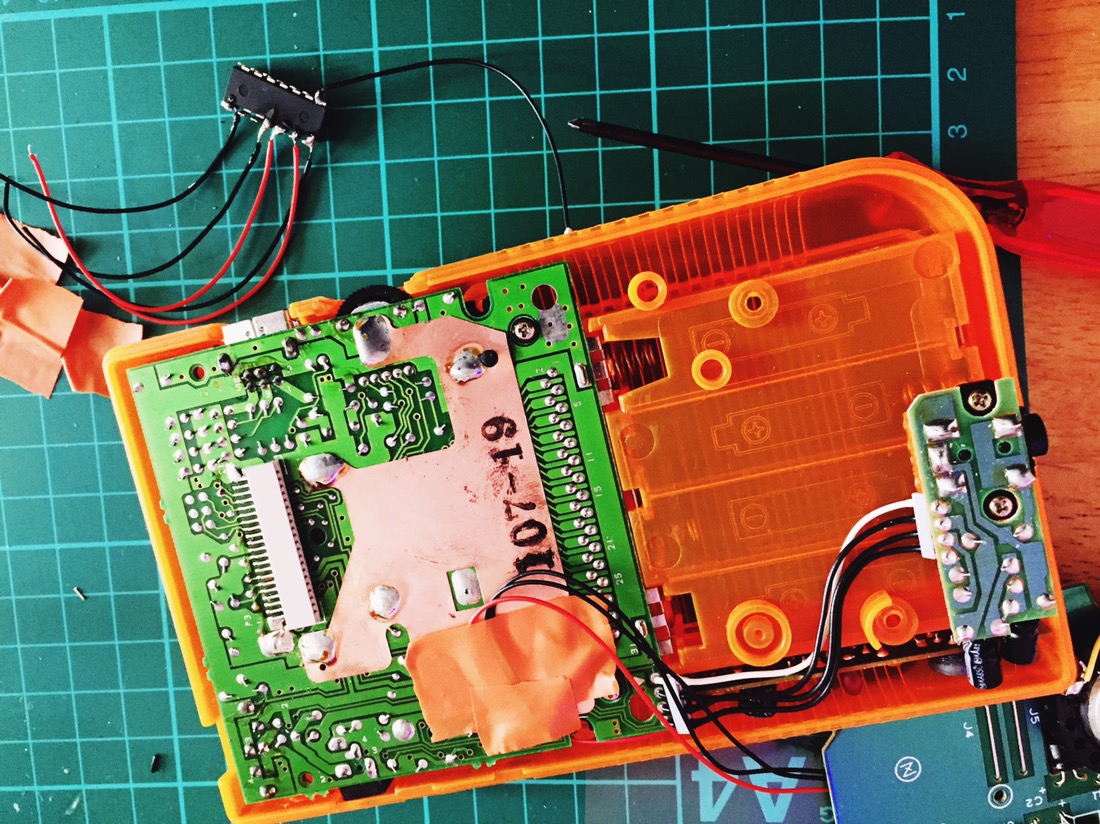
One of my work colleagues read about my Gameboy fiddling and kindly posted up one of his old grey DMGs that was destined for the charity shop to see if I could do anything with it. I decided to document its transition.
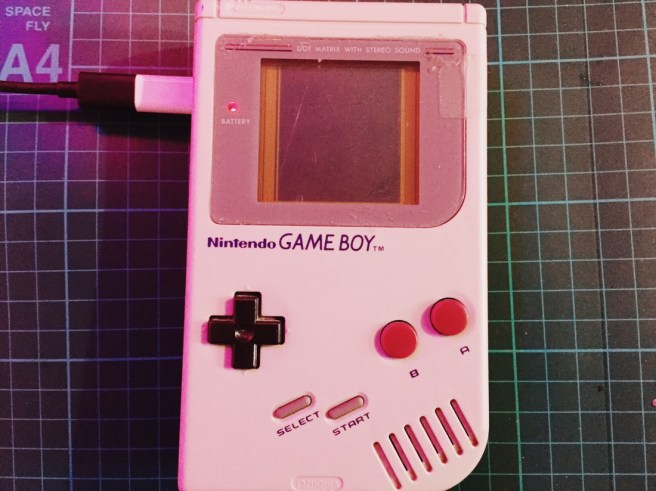
It was in the kind of standard condition for a used Greyboy of its age. The case was a bit roughed up and the LCD screen had vertical lines of dead pixels at either end. You can make them out below.
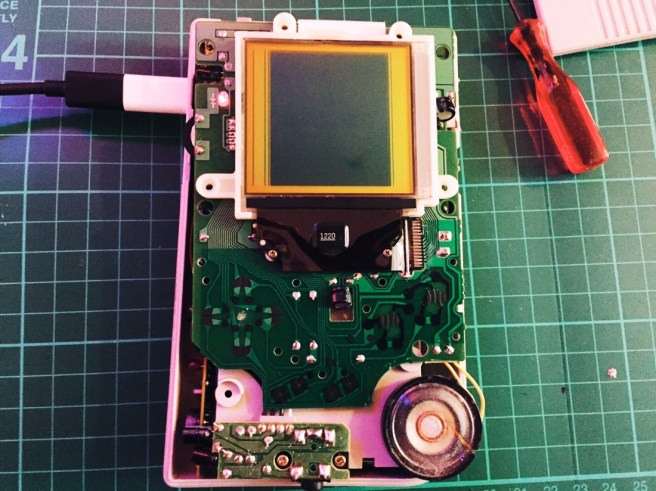

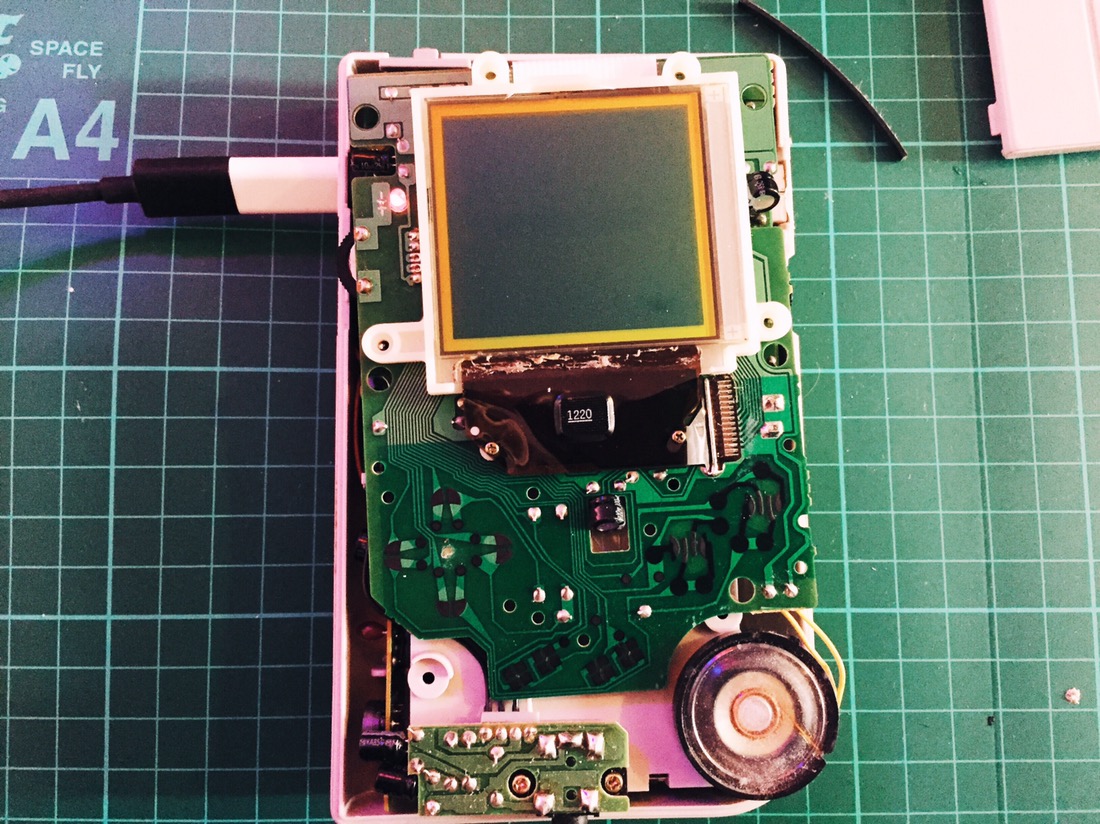
First things first was to see if I could fix that, as if the screen was dud, it would only really be worth spare parts. Luckily, it’s a pretty simple job, and before long the screen was as good as new.
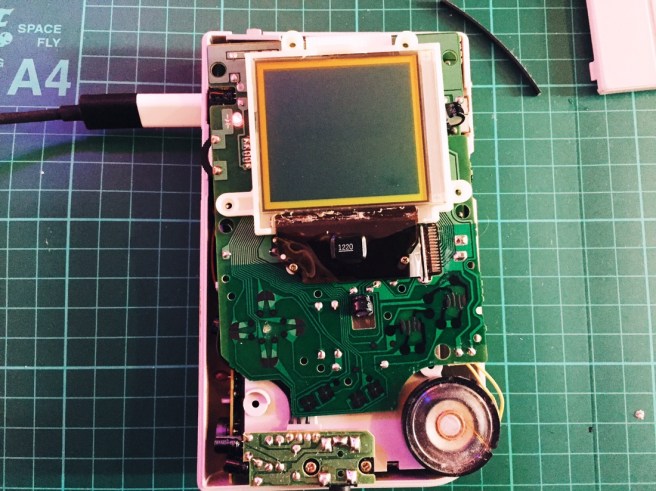

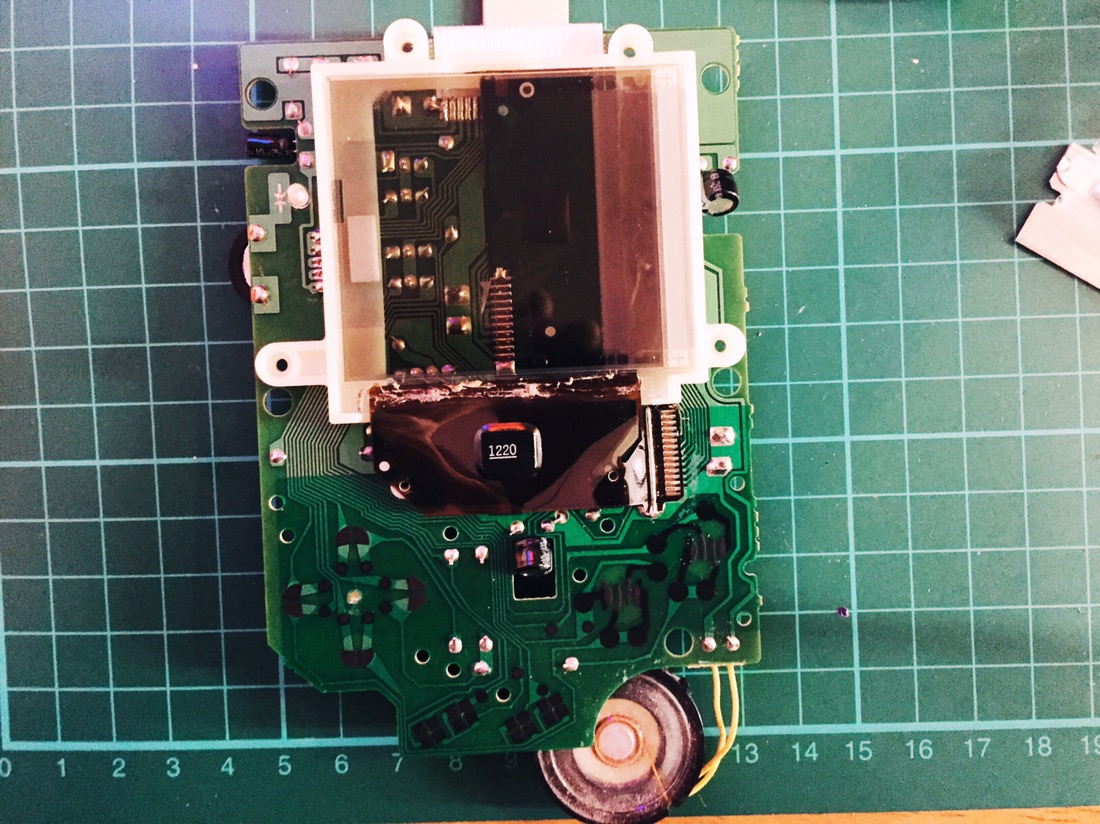
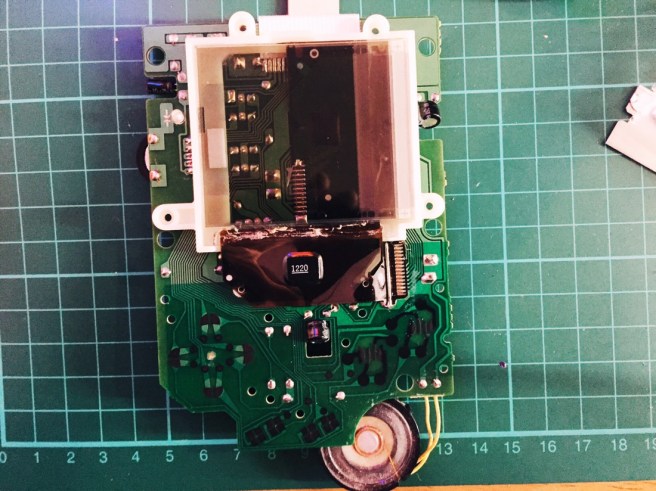
With that, it was time to set about preparing the screen to put a backlight in. The old Gameboy screen was always a nightmare to see, so installing a new LED light source is a must. It’s also a tricky process, involving removing the foil back off of the screen itself. One wrong move and you can trash the whole thing. As it turned out, the adhesive on this particular Gameboy hadn’t corroded away, meaning it was a pretty smooth and simple process.

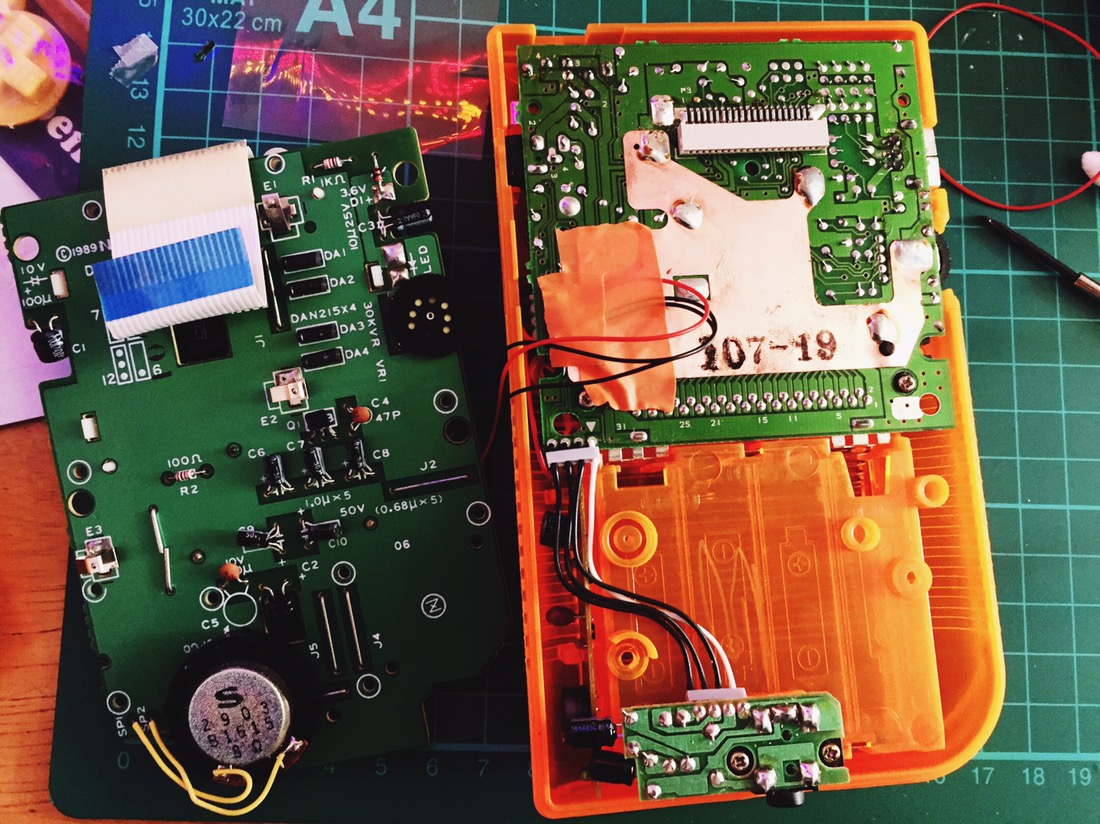
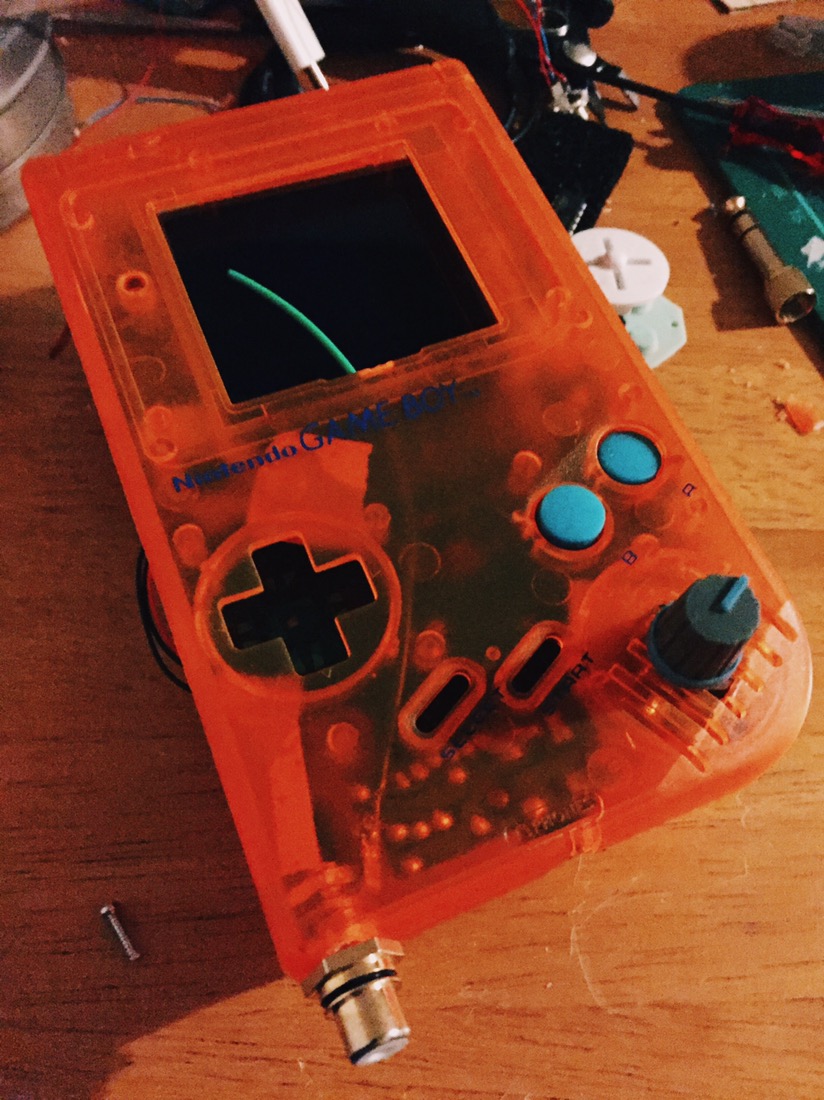
Then I put the Gameboy guts into a new case: transparent orange, which is a colour that was never available for the DMGs back in the day as far as I’m aware.
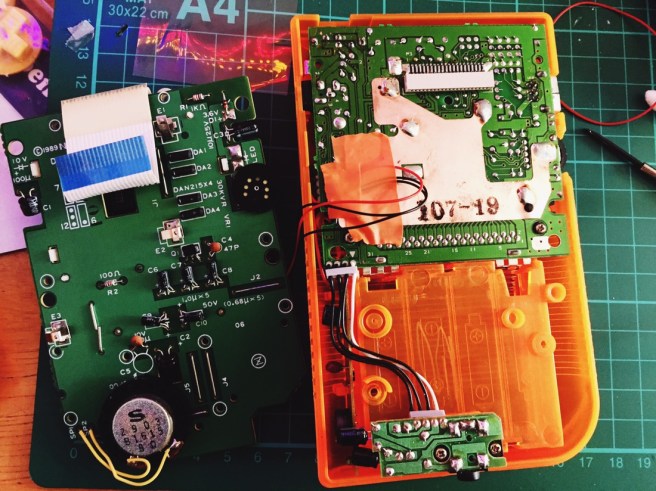

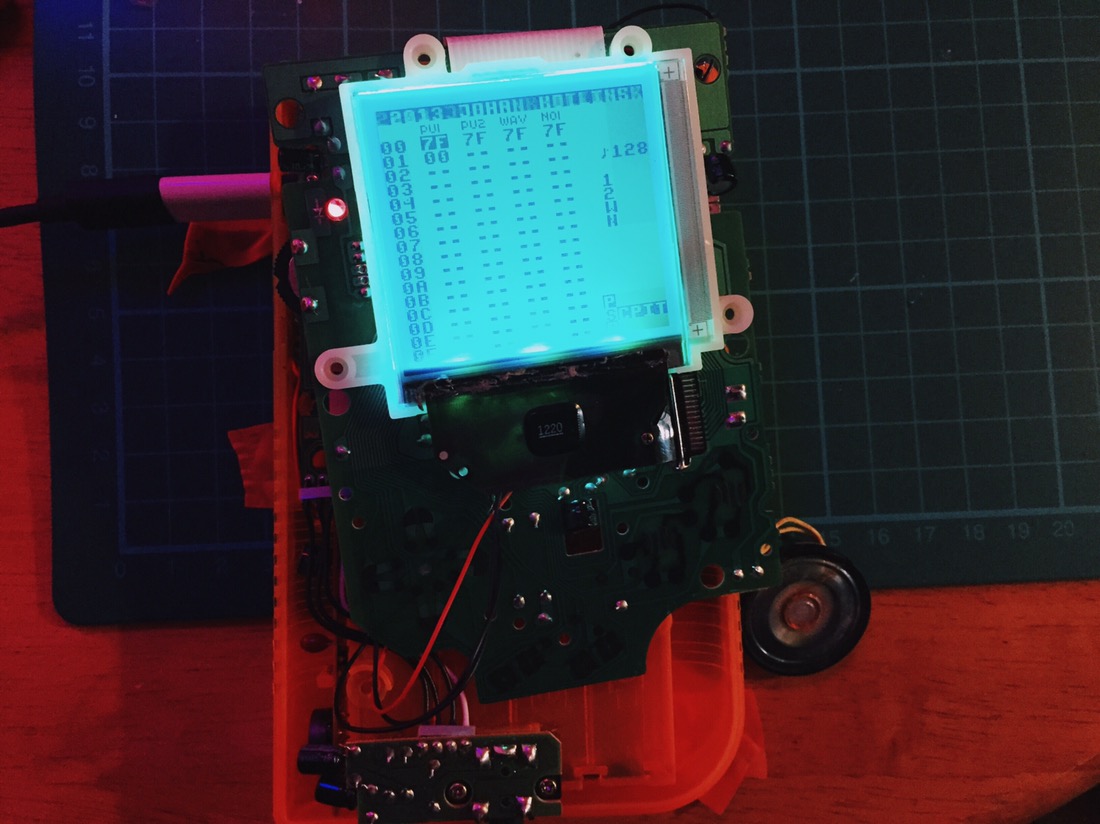
Next up, I installed a hex inverter chip to ‘bivert’ the screen. The new backlight polarising filter inverts the screen already, and so this step inverts it back to the regular display type, increasing the contrast in the process. It’s fiddly, but drastically improves the clarity. I’m pretty blind, so any picture improvement is a win.
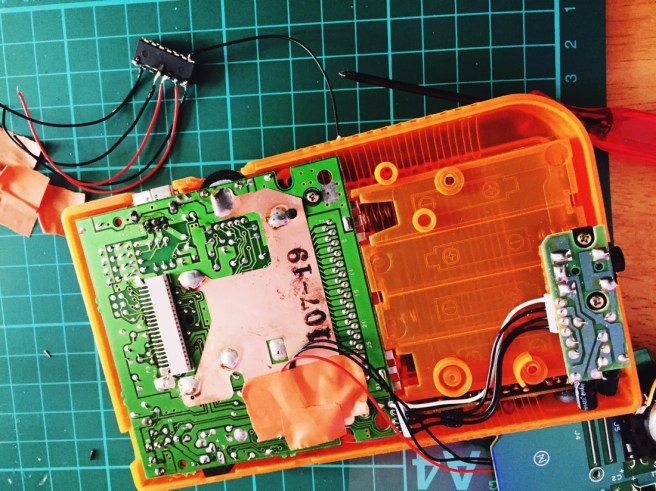

It took a while as I didn’t realise that the backlight kit was missing a crucial resistor, and I had to go through each step to test it all again. A good lesson in not trying to do too many things at once.

Here’s the screen all lit up and biverted.
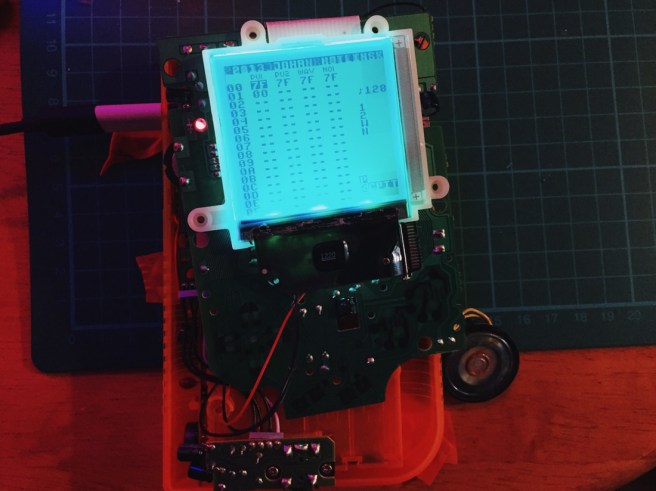

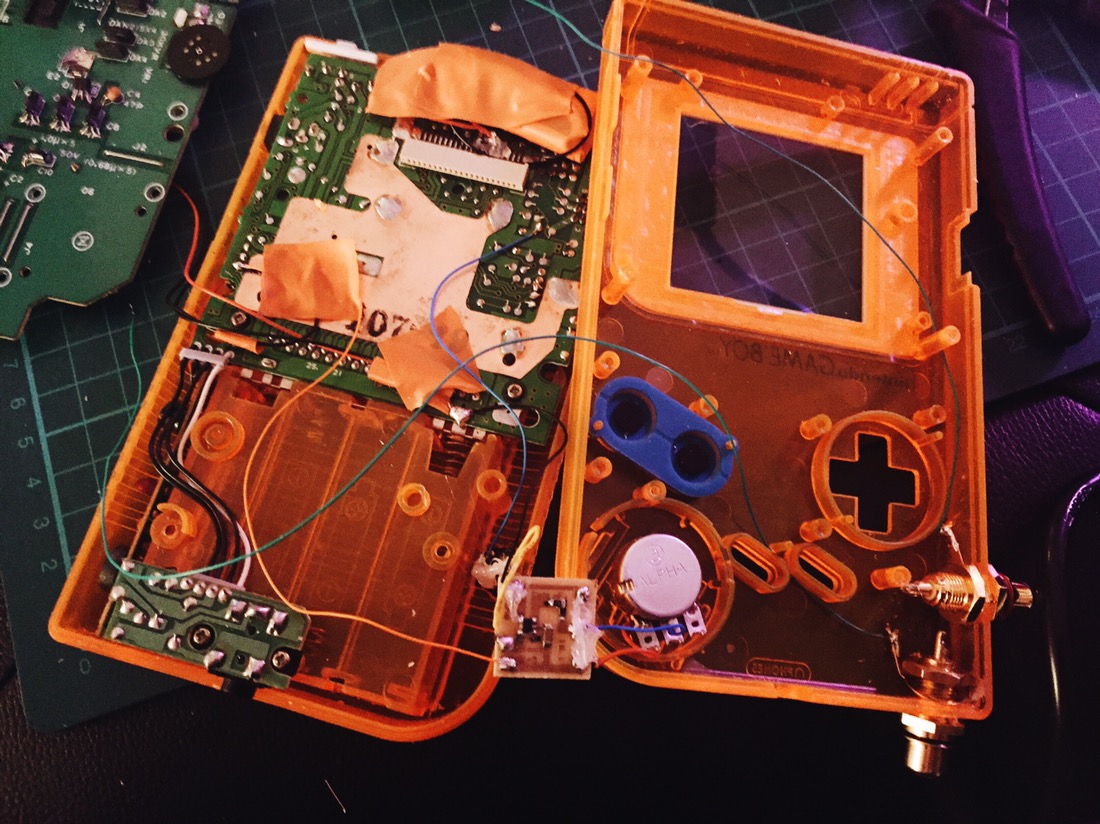
Next was installing a pitch oscillator that I had had lying about for ages. In other words, a small knob that changes the clock speed of the Gameboy to run faster or slower. What’s the point in that? For games it helps speed up boring parts that you can’t skip, but for music it lets you slow down or speed up things with the corresponding pitch change. Pretty damn cool.

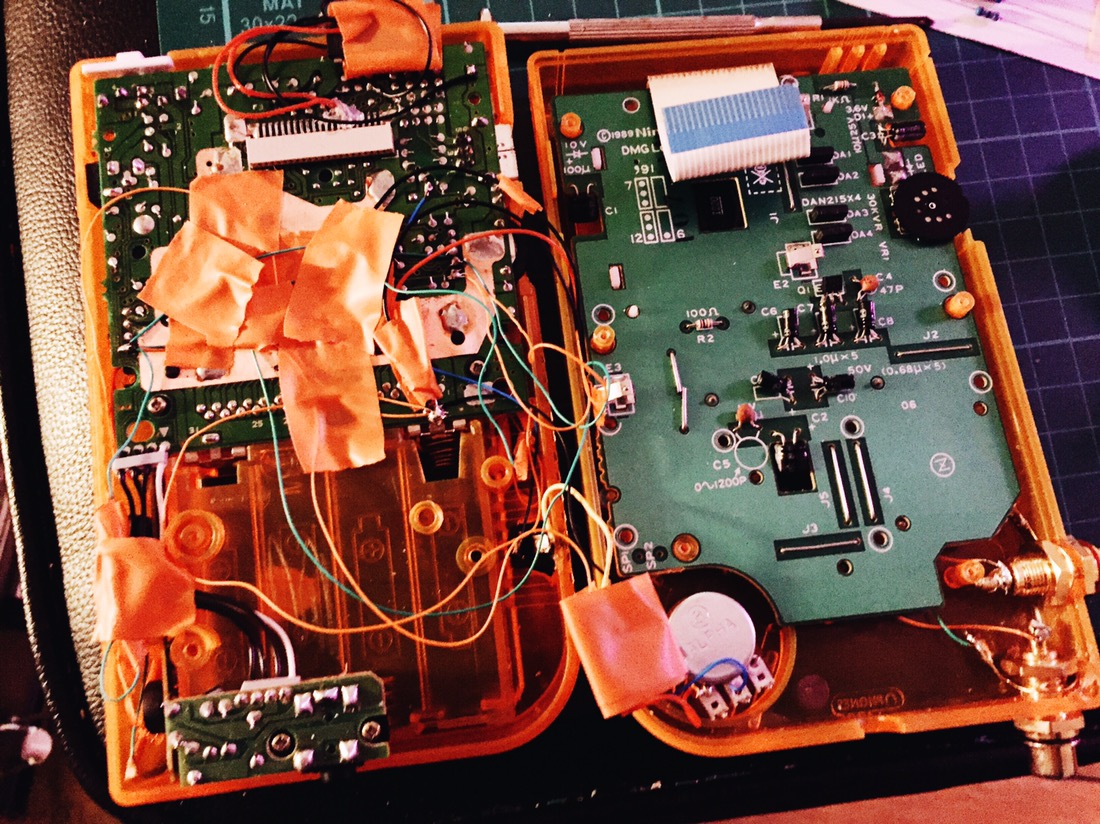
The potentiometer fits into the space where the speaker sits, so it had to go.
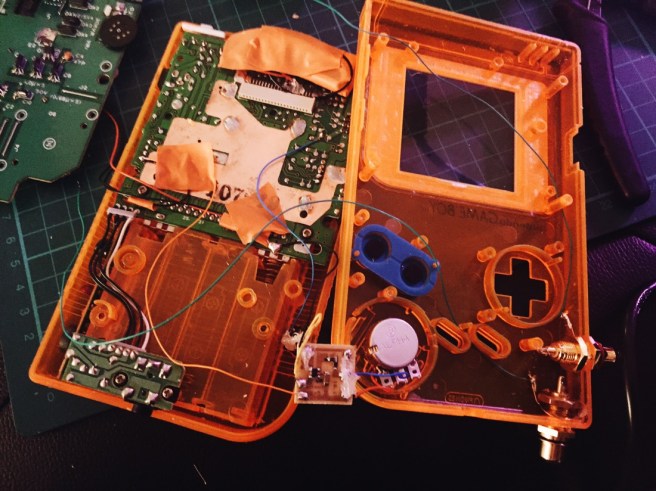

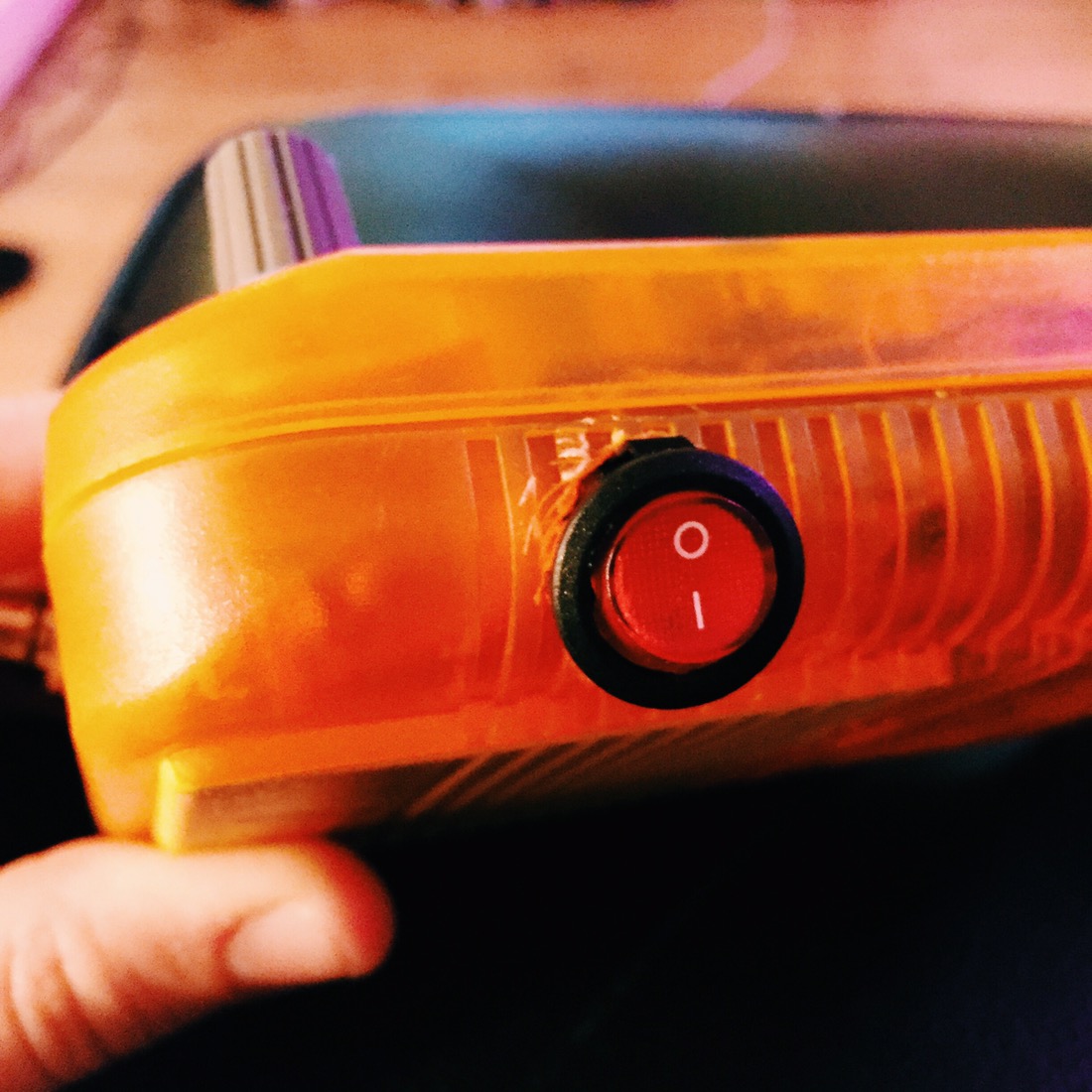
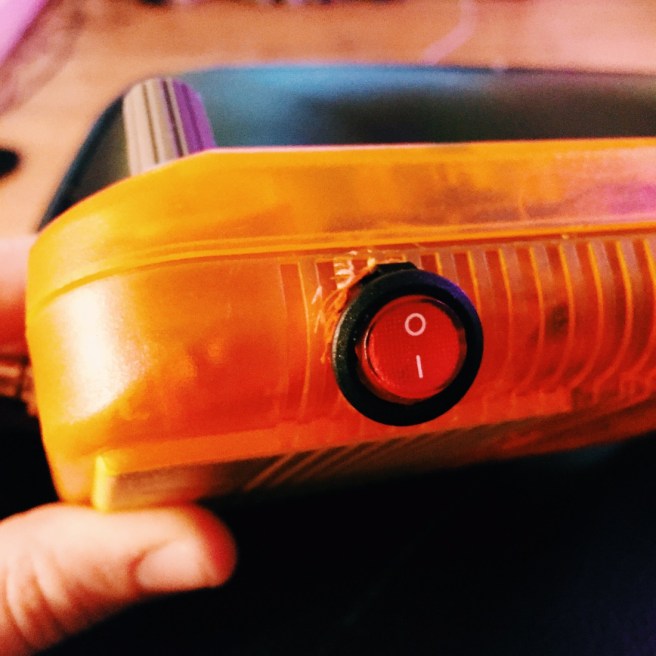
I included a switch to turn the pitch oscillator on or off, which turned out to be a bit too big for the case…

I also wired up two RCA jacks for line level audio output. This wasn’t the ideal place to put them, but space was tight because of the other mods. I had begun to install a 3.5mm line out in the same position, but realised that the plastic seemed to be much thicker than in the other model I had done this on, and so the barrel was too short to fit through. RCA it is!


There was a lot of wires in there by this point. Just for fun, I decided to throw in some orange LED lights to give the case a nice glow. By the end of that, it was a bit tricky getting the case to go back together neatly.

At least I used appropriately coloured electrical tape…
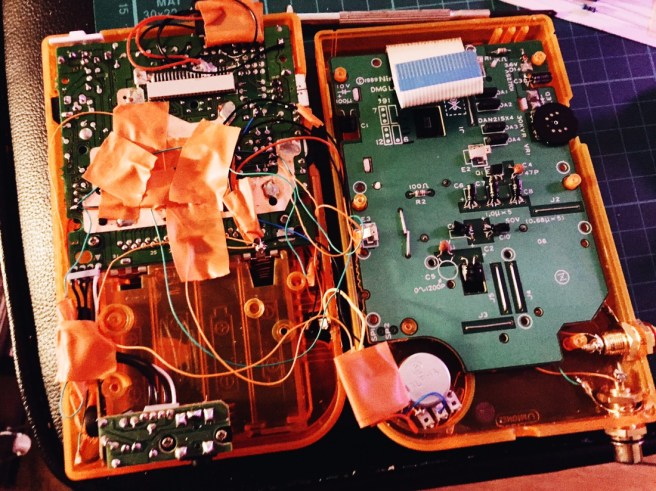

So after a good few hours working on this beast, spread across a few days, here’s the finished result:


The case cutting and drilling leaves a lot to be desired, with rough edges obscured by the buttons and pots… But you can’t really notice. Despite that, I’m pretty pleased with the end result. Everything works, I learned a fair bit, and an old Gameboy has a new lease of life.
New EP: ‘really something’

After the last few posts concentrating largely on gear and production stuff, it’s good to be able to follow up with one centred on music.

I had planned to wait until I had an album together before releasing anything, but it became clear that a number of the earlier tracks had a sound that naturally branched off in a group. As a result, my first release in 4 years will be a 5 track EP titled ‘really something’. I can’t quite believe it’s been that long, but there we go.

albumcover.png

The tracks themselves are all fairly laid back, and stripped back a lot from my previous sample-heavy chiptune releases. The only time the pulse really increases a shade is on ‘Down Street’, a track which previously only ever featured on the ‘Relycs‘ collaborative release that was put out on cassette, and dedicated to abandoned tube stations.

It feels like a nice transition. Listen out for my pal Haigie’s laugh on track 5.

The whole thing is up to stream/download for free over on bandcamp.


Tracklist:

  1. more is less
  2. out of milk
  3. gender neutral robot
  4. Down Street
  5. more is more